<img height="1" width="1" style="display:none;" alt="" src="https://px.ads.linkedin.com/collect/?pid=4668217&amp;fmt=gif">

AI Agents for Customer Service See more

AI troubleshooting & resolution

Deterministic where you need it. Flexible where you don't

The specialist troubleshooting layer for telco — it diagnoses and resolves across your full product and network variability, with you setting how much latitude the AI has, scope by scope. Plug it into any channel, or invoke it from your agentic layer via A2A, MCP or APIs.

See In Action
Hero ai troubleshooting

THE FRONTIER ISN’T CONVERSATION. IT’S RESOLUTION

You’re adopting agents. Then come the cases that demand certainty.

In technical resolution, many use cases can’t tolerate an AI that improvises — the answer has to be correct and controlled. And the two options the market offers pull in opposite directions.

Rigid Workflow

Control, but not scale

Predictable behaviour that collapses under real telco variability — unmaintainable as products, technologies and devices multiply.
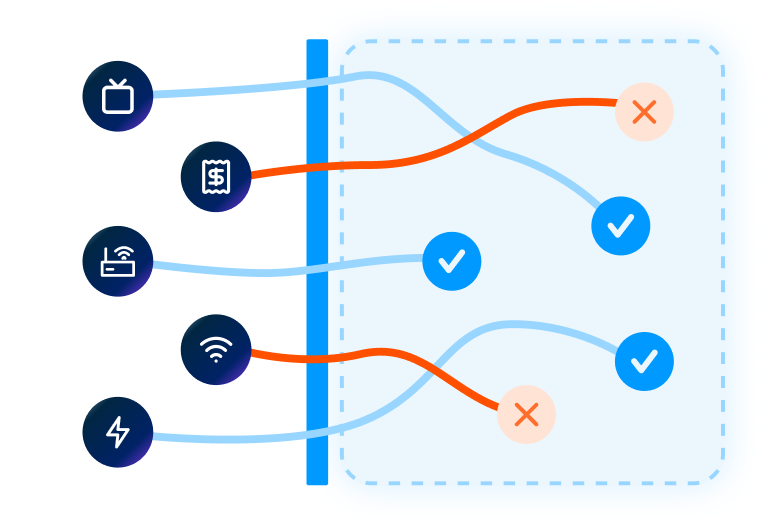
Open Agents

2: Flexible, but uncontrolled

They adapt to anything — including improvising a fix and acting on it, which no operator will permit over their network and their customer.

GOVERNED FLEXIBILITY

You don’t have to choose between control and flexibility

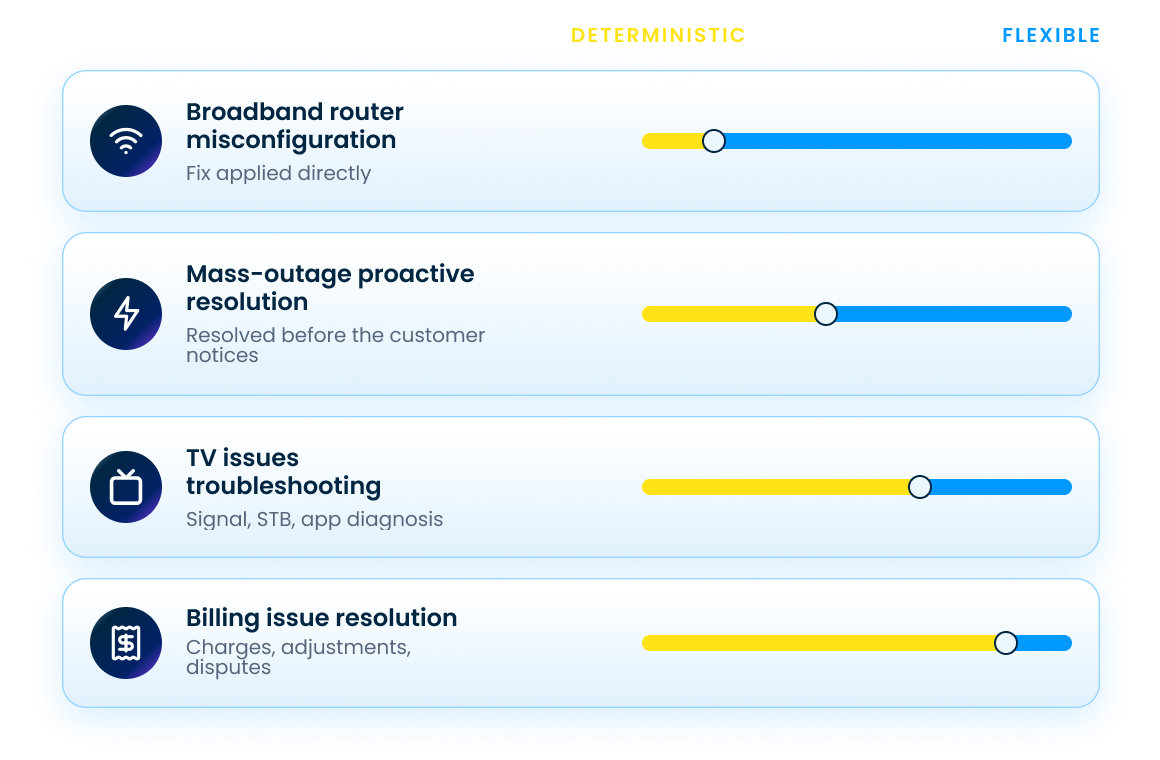
Schaman is deterministic where your use cases require it and open where they don’t — and you decide which is which. Scope by scope, you set how much latitude the AI has, from fully declared and controlled to open and AI-proposed. One capability, spanning the whole range, with the dial in your hands.

You set where latitude ends

Declarative foundation

Always on, under policy

Declared root causes Approved resolutions Detection context Scopes & policy

Agentic latitude

Where you allow it

Hierarchical agents Agentic RAG Open Target NL interface contracts
FULLY DETERMINISTIC MORE OPEN

CONTROL WITHOUT THE SCALE TAX

Control that scales across thousands of diagnostic scenarios, and actually resolves them

Here, scale means coverage: thousands of diagnostic scenarios handled with control, resolved end to end rather than escalated. Most approaches buy that control with hardcoded flows or ever-growing prompts — which is what caps their coverage. Schaman’s control comes from declared knowledge, so it scales instead of fighting scenarios.

Other solutions
Schaman
How Control is Achieved

Hardcoded rigid flows — or ever-growing prompts — built by hand for each case

Control is a property of declared, approved knowledge — no rigid flow required

Cost of a New Scenario

Another brittle branch or prompt to build and maintain

Declare one bounded unit; the system composes it everywhere (~a day)

Net Effect on Scale

Control is bought by giving up scalability

Control and scale don't trade off — you keep both

HOW LEARNING BECOMES PREVENTION

From resolved incidents to proactive resolution

Two capabilities working together: one turns every outcome into operational knowledge, the other acts on that knowledge before customers are affected.
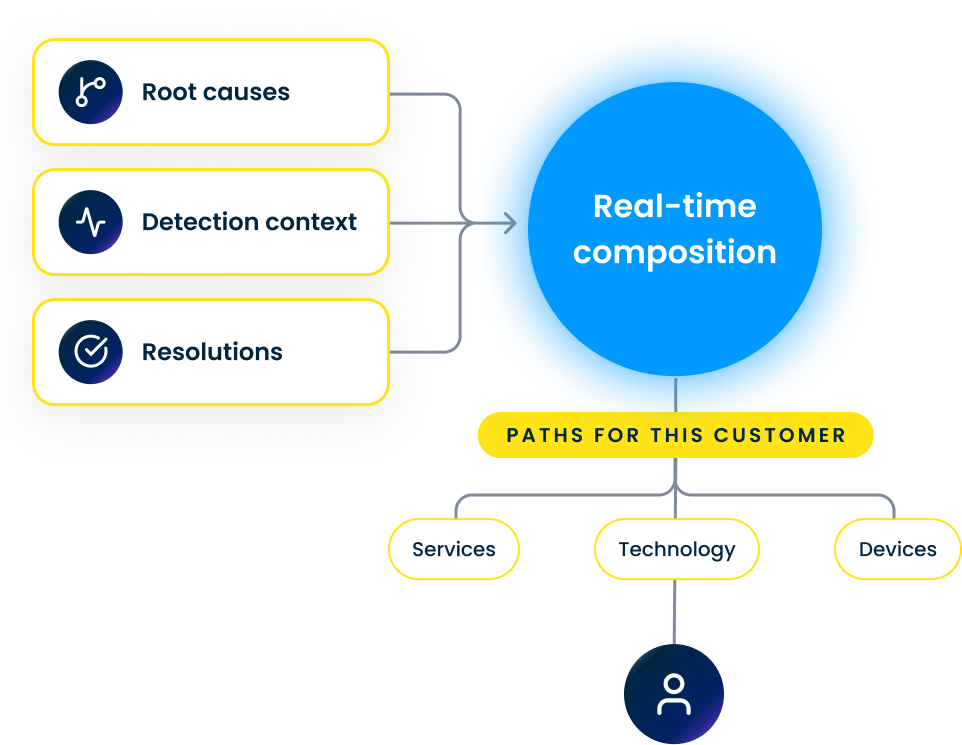
Declared knowledge, composed live

Composed per customer, in real time

From declared knowledge — the root causes it knows, each is detected, how each is resolved — Schaman determines which problems this customer could have, how to diagnose them for their specific case, and which resolution fits. The company governs resolution knowledge instead of maintaining enormous workflows.
Image card 1
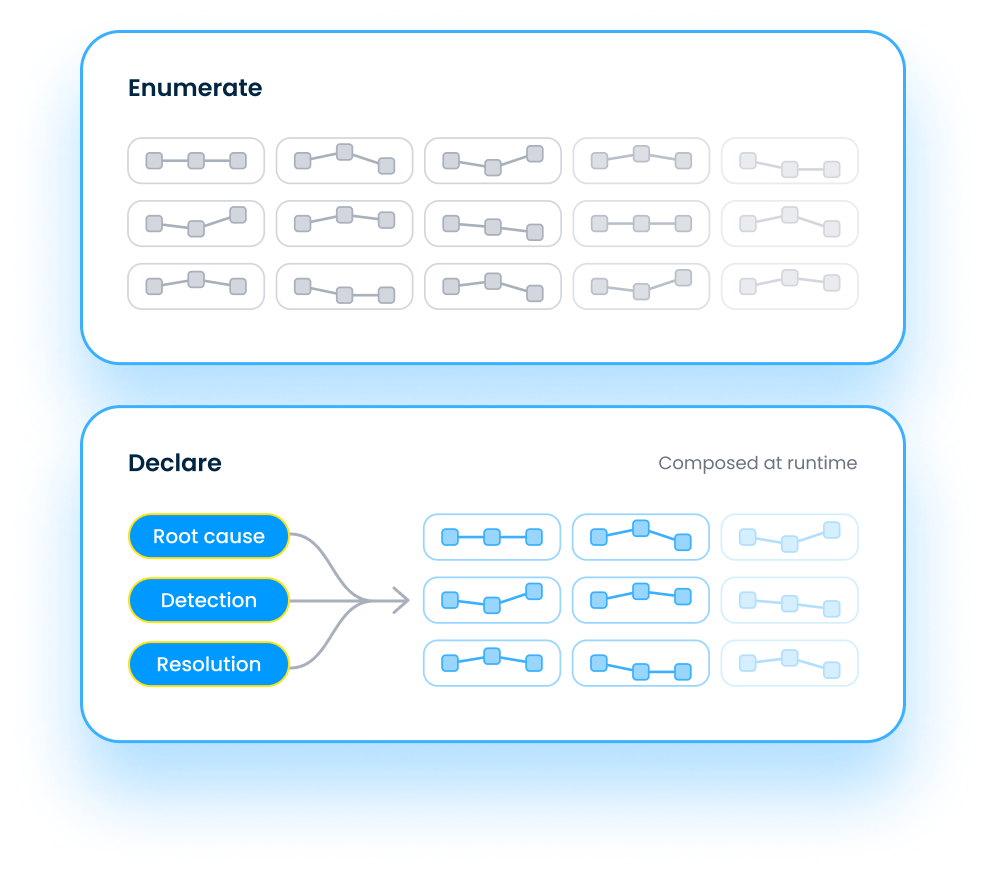
Declaration is modular. Enumeration is combinatorial.

Declare a unit once. Compose it everywhere.

Enumerating every path — product by technology by device by configuration by version — is combinatorial, which is exactly why the rigid approach either explodes or turns brittle. Declared knowledge is bounded and composable: declare a root cause once and the system recombines it across countless situations at runtime.

The build economics show it. A new root cause and its resolution go live in about a day; a new data source over an existing entity in about two - small, self-contained units, not a rewrite of everything they touch.
Image card 2
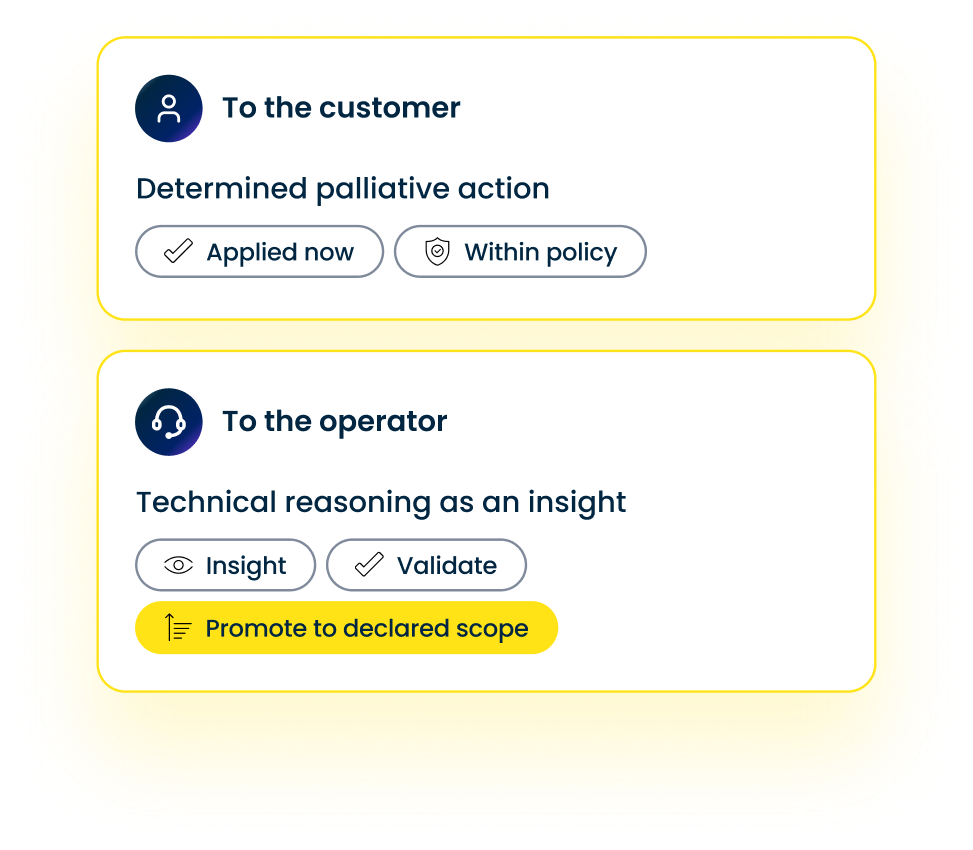
Reasoning becomes a proposal, not an action.

It computes only what the diagnosis needs

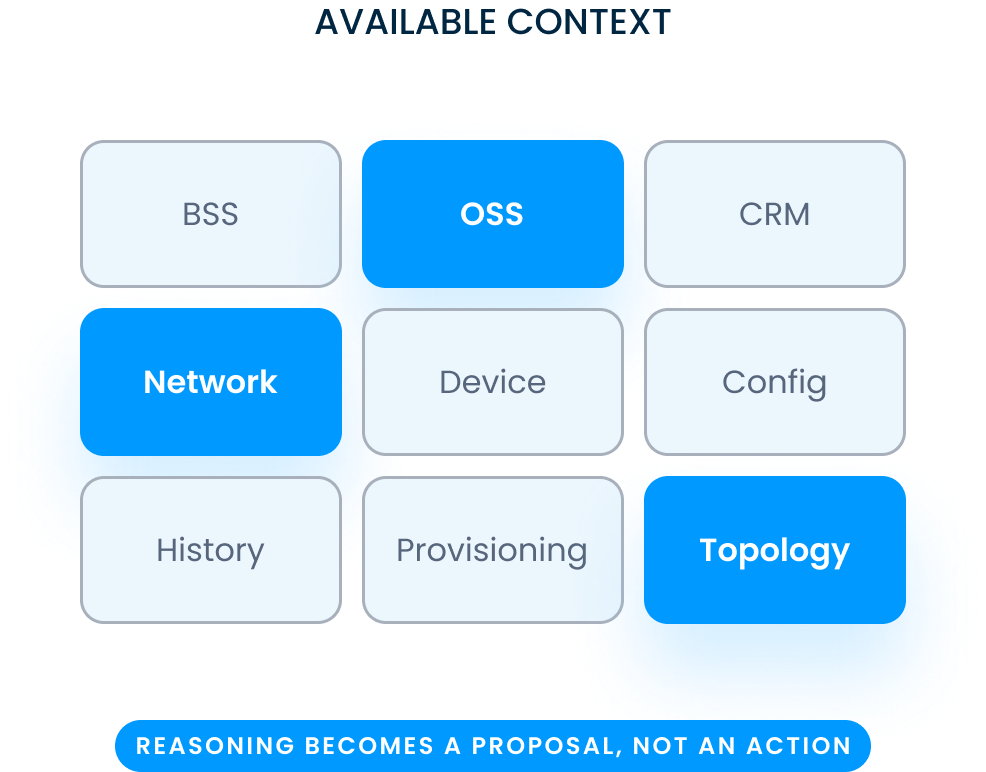
Because the path is composed live rather than pre-scripted, Schaman doesn't pull everything about a customer and then work out what mattered. At each step it determines the minimum information required to advance the diagnosis, and requests only that. Fewer, better-targeted calls to your BSS, OSS, CRM and network systems mean lower integration load, lower cost per resolution and faster answers — the efficiency side of the same real-time composition.
Image card 3
See modular reasoning explained

It reasons within declared bounds — and never acts on a guess

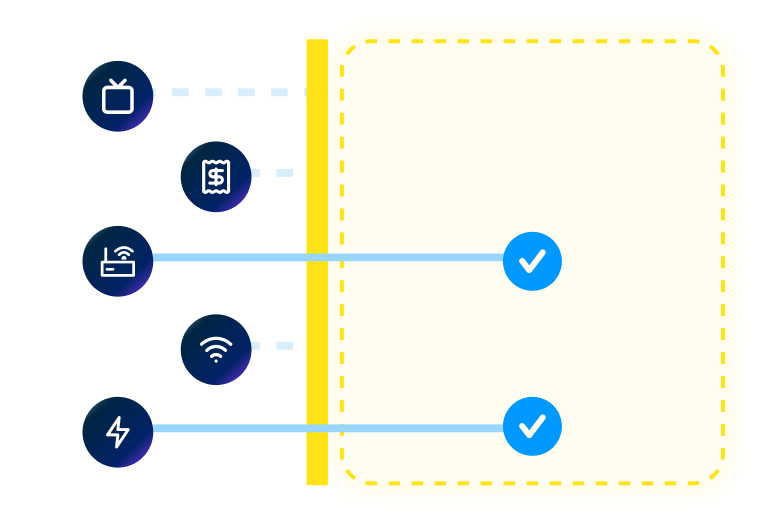
The same declared knowledge that lets Schaman scale also bounds what AI may do in a deterministic scope, when something novel appears — including an incident that maps to no known cause — it doesn't invent a fix and act on it.
Image card 4

TWO MOMENTS, ONE ARCHITECTURE

It resolves the case now – then learns from it next.

The Gateway, Context Orchestrator and Troubleshooting Framework diagnose and resolve each case under control, in the moment. Every insight the operator validates then flows into the Learning & Insights hub and the Autonomous Resolution Engine — so the next customer with that issue is resolved automatically, or never has to make contact at all.

See Autonomous Operations
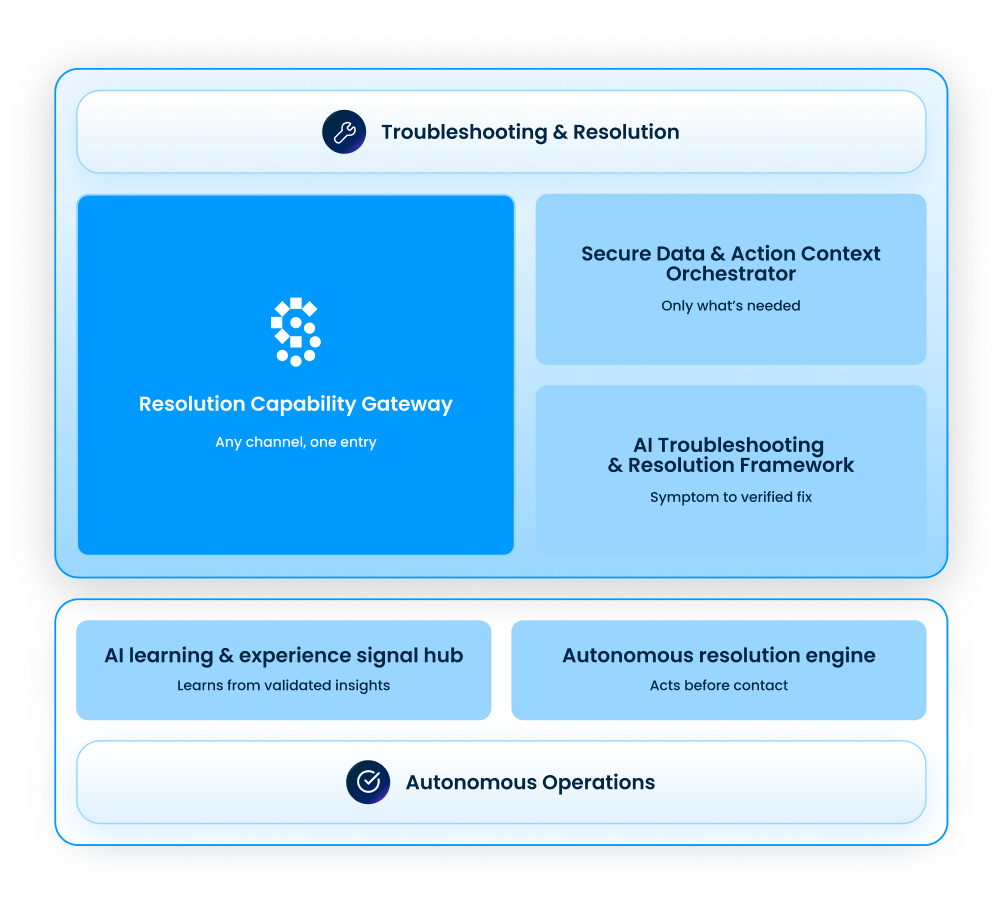
Diagrama 2

The control your use cases require — at the scale they need.

Add specialist telco resolution to any channel or to your agentic layer — deterministic where it matters, flexible where it helps, and governed everywhere. You decide the mix, Schaman keeps it scalable.

Ready to transform your customer service with Resolution Intelligence?