R&D Projects with Public Funding
Algorithm with Supervised Machine Learning for Diagnosing Customer Issues
The objective of the project "Algorithm with Supervised Machine Learning for Diagnosing Customer Issues" is the development of an innovative algorithm based on supervised machine learning techniques. This intelligent system dictates the order of questions, i.e., an algorithm capable of optimally and efficiently formulating questions that lead to and are able to diagnose the problem affecting the customer service.

The project starts with the knowledge of the possible problems that can affect customer service and the questions necessary to detect such a problem. Based on this training data, supervised machine learning techniques (such as probabilistic, non-probabilistic models, deep learning...) have been used to obtain the optimal way to ask questions, self-orchestrating the order of their evaluation, allowing for the most optimal solution for symptomatic and mixed user stories. This contributes new technical improvements to the company's previous developments in the field of technological solutions while providing a more secure environment through support tools.
The incorporation of Artificial Intelligence techniques as the main technology, specifically using machine learning methods (ML), has allowed for improved efficiency as the main objective of the SCHAMAN product. It is based on detecting problems presented in customer service, minimizing risks of various severities that may affect its proper functioning, and improving the quality experience for end users of advanced telecommunications services.
The result achieved represents a significant advance and contribution to one of the most widely implemented mechanisms in the business world, which is work organization through workflows. This is done through new techniques for generating, preparing, and adapting the dataset used by pre-existing AI algorithms, abstracting their capabilities and developing those non-existent for the generation of the new algorithm. It efficiently and accurately classifies a wide range of customer interactions, improving response times and the overall experience and satisfaction of customers. At the same time, it can identify emerging patterns of customer service complaints. This is a highly scalable and adaptable solution to different types of complaints and variations in the language used by customers, providing a solid foundation for future expansions.
Participants
Schaman Customer Experience Spain, S.L.
Execution period
2022 - 2024
Funding
Project funded by the public business entity Red.es, attached to the Ministry of Economic Affairs and Digital Transformation, charged to the funds from the Recovery and Resilience Mechanism within the European Recovery Instrument ("Next Generation EU"), in accordance with the Recovery, Transformation, and Resilience Plan.
Call
2021 Grants for Research and Development Projects in Artificial Intelligence and Other Digital Technologies and their Integration into Value Chains. C005/21-ED
File
2021/C005/00144664
Budget
602.103,45 €
Clustering System and Topological Analysis for the Discovery of Unknown Technical Problems
The objective of the project “Clustering System and Topological Analysis for the Discovery of Unknown Technical Problems” was to research, develop, and validate an automated data analysis system focused on those support sessions in which the Schaman platform’s diagnostic mechanisms fail to identify the user’s technical problem. In other words, a system capable of automatically grouping undiagnosed cases to reveal common patterns that point to technical problems not yet included in the root cause catalog.
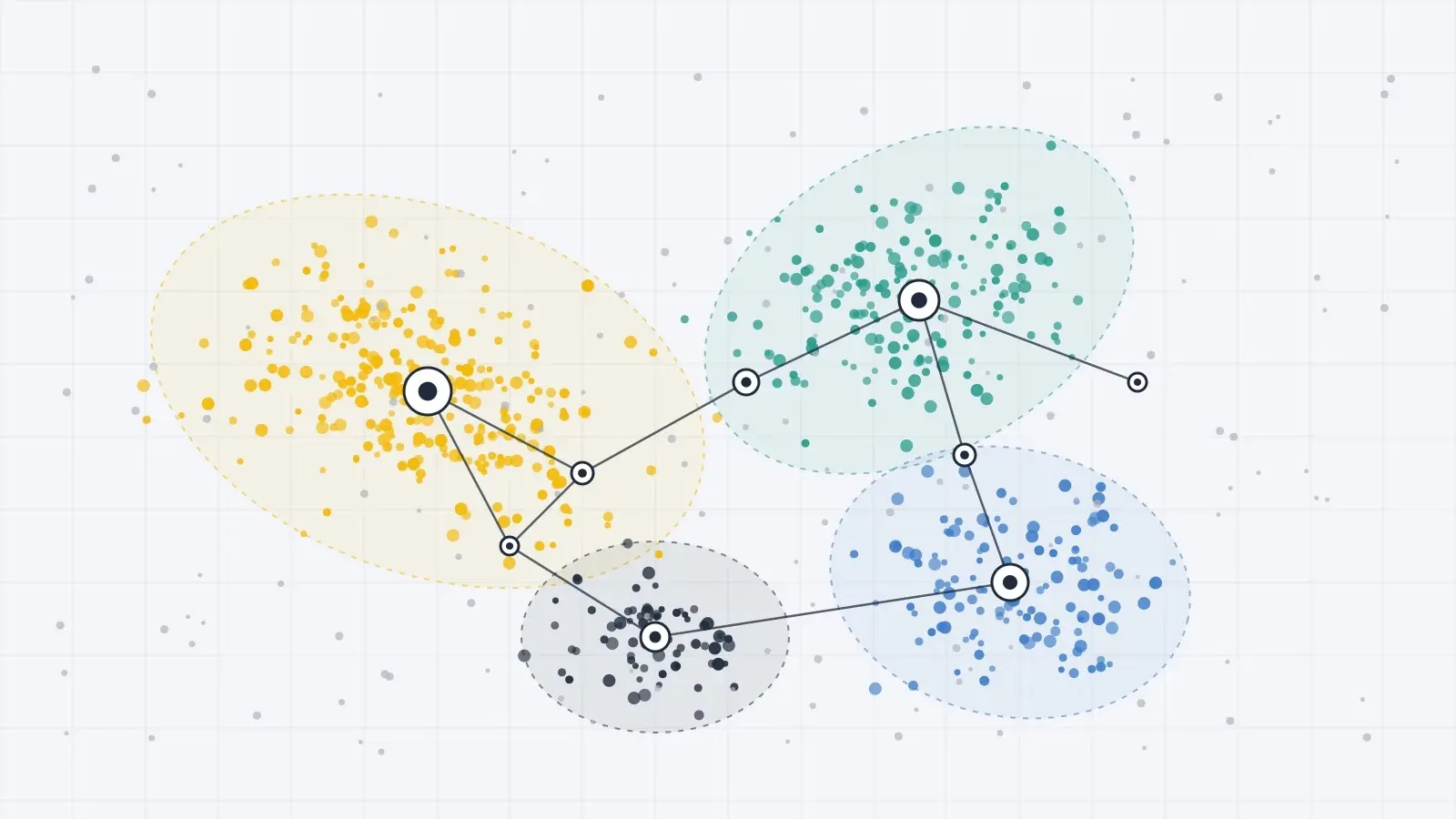
The project is based on the analysis of anonymized real-world data from diagnostic sessions in the telecommunications sector, focusing on root causes related to slow service and service outages. Based on this data, an operational rule was defined to distinguish between diagnosed and undiagnosed sessions, and various unsupervised clustering techniques suitable for mixed data (categorical and numerical) were evaluated, such as K-Prototypes and HDBSCAN with Gower distance, supported by analysis and interpretation tools such as CatBoost with SHAP, t-SNE, Cramér’s V coefficient, heatmaps, and boxplots. Complementarily, the application of Topological Data Analysis (TDA) techniques—using persistent homology and Mapper—was experimentally evaluated as a potential improvement to the clustering process.
The research led to the selection of HDBSCAN with Gower distance as the foundation of the system, as it provides more homogeneous and better-separated clusters and allows for analysis without first specifying the number of clusters. The results were incorporated into a new feature integrated into Operational Intelligence, Schaman’s analytics module, called “Session Groups without Diagnosis.” This feature automates the collection of technical parameters at the source, the classification of sessions, the execution of the clustering process, and the presentation of results using indicators and visual interpretation tools. Validation using real historical data showed that the classification rule correctly reproduced 98.5% of cases, and that the system was capable of identifying distinct groups associated, for example, with specific router models and firmware versions.
The result achieved represents a significant advance in the platform’s ability to learn from issues it cannot yet diagnose. In addition to the technological system developed, the project has generated relevant knowledge regarding the applicability of clustering and topological analysis techniques in technical support environments, as well as the importance of the quality and completeness of symptom data for identifying new failure patterns. This technological and knowledge base will enable the system to continue evolving as new data becomes available, helping to continuously expand the catalog of root causes and improve the end-user experience.
Participants
Schaman Customer Experience Spain, S.L., with scientific and technical collaboration from the Polytechnic University of Madrid (UPM).
Funding
Project funded by the General Directorate of Research and Technological Innovation of the Regional Ministry of Education, Science, and Universities of the Community of Madrid, and co-funded by the European Union.
Call for Proposals
2023 Call for Grants for the Development of Innovative SMEs in the Community of Madrid.
File Number
09-PYN1-00058.5/2023
Amount of Grant Received
€224,389.97